






Independent researcher, systems architect, and creative technologist
I build auditable AI systems, formal tools, and interactive media—turning ambitious ideas into inspectable, reproducible work.




Featured work · All repositories · Sponsor open work · Music
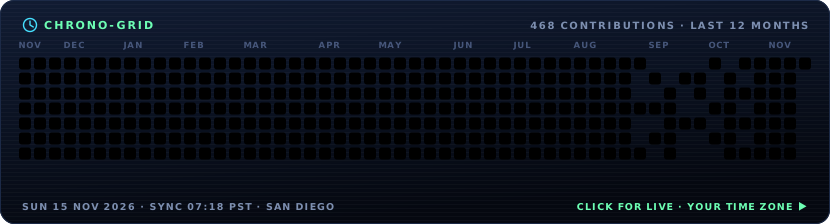
That is my real contribution graph. It melts into the time, plays Pong inside the digits, folds its right-hand side into a self-solving cube (all in contribution greens), and melts back. On the live page, click it and it becomes your time.
I build things that shouldn’t exist yet. Then I make them rigorous.
- Auditable AI and verification: tools that bind computational claims to evidence, checking mechanisms, provenance, and explicit limits.
- Formal and mathematical systems: executable research across Lean, ordinal arithmetic, logic, and the broader hyperfield ecosystem.
- Creative technology: AI-assisted games, music systems, creator tools, and experiments that make difficult ideas tangible.
| Project | What it does |
|---|---|
| Verifier | Implements the Verifier Standard (VSTD) for portable, bounded, refutable computational evidence and provenance graphs. |
| Lean4 Explainer | Builds navigable proofsites from Lean 4 code using an explanation layer designed for higher-order specificity. |
| Hyperfields | Provides a Lean 4-checked, source-pinned map of the public hyperfield ecosystem. |
| Hypermath | Develops a formal universe from one primitive operation, with a Lean translation and explicit open proof obligations. |
| Ordinatics | Explores exact ordinal arithmetic and bounded typed satisfaction in an ordinal-first computational framework. |
- Evidence before confidence.
- Reproducible artifacts before broad claims.
- Open obligations and unknowns stated plainly.
- Ambitious ideas paired with mechanisms that can be inspected, tested, and challenged.
I publish open research, tools, experiments, and documentation across AI, computation, mathematics, and creative systems. If that work helps you think, build, or verify something more effectively, sponsorship helps fund more of it.
For a project-specific question or collaboration idea, open an issue in the relevant repository with a concrete use case, counterexample, or proposal.
How an interactive thing lives inside a README
A profile README cannot run JavaScript, so this page is built in two layers that share one set of source files.
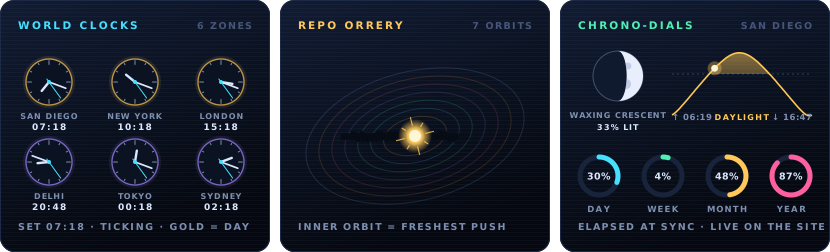
1. The animated images above are script-free SVGs (CSS and SMIL animation only), drawn by scripts/build.mjs from my real GitHub data. A scheduled workflow rebuilds them once daily and publishes them to a throwaway chronos branch, so main never fills up with history. The clock inside the graph is a snapshot labelled with the time it was taken (SYNC 17:50 PDT). The Pong match and the cube are deterministic simulations that replay on a loop, and the glow of each digit pixel is the activity of the day it covers.
2. The Chronosphere is the live version, served from GitHub Pages with no dependencies, no trackers and no build step:
- Click the graph. It reforms into your time, read from your browser's time zone. Click again and it returns to the real activity.
- Take a paddle. Move over the clock and you play PAST against FUTURE inside the digits.
- Watch the cube. It scrambles and solves itself on a shared clock, so everyone who is looking sees the same turn at the same moment. Drag to orbit, click to reshuffle.
- Use the time machine. Slide every instrument a day or an hour, or run time at ×3600.
- Pick a place.
?zone=tokyo,?zone=londonand friends deep-link to a city's time;?mode=activityholds the graph;?stillturns motion off.
Your time zone never leaves your browser. The page respects prefers-reduced-motion, and every animated image has a static fallback.
Everything here runs on time, so new instruments are cheap to add: an instrument is one small object registered in site/js/instruments.js. Notes for tinkerers are in docs/CHRONOSPHERE.md.