Open source AI visibility tracking and optimization.
Learn more »


Tip
Don't want to self-host? Elmo Cloud runs the same open-source platform for you, with managed hosting and automatic updates, from $29/mo. Start with Cloud →
Elmo is an open-source, self-hosted platform for optimizing your AI visibility, which is also known as:
- Answer Engine Optimization (AEO)
- Generative Engine Optimization (GEO)
- LLM Optimization (LLMO, which is where the name Elmo is from)
Buyers increasingly ask AI before they search or visit a website. Elmo tracks how AI answer engines like ChatGPT, Claude, Perplexity, Gemini, and Google AI Overviews mention, cite, and describe your brand, so you can benchmark competitors, uncover citation gaps, and win more recommendations in AI answers.
It's a free alternative to tools like Profound, Peec, and Otterly. You can run it on your own infrastructure, own your data, and audit exactly how every metric is calculated.
Try the live demo at demo.elmohq.com to see how Elmo tracks prompts and analyzes citations.
| Dashboard Overview | Visibility Tracking |
|---|---|
 |
 |
| Share of Voice | Citation Analysis |
 |
 |
| Query Fan-Out | Opportunities |
 |
 |
| Sentiment | Responses |
 |
 |
- Visibility — how often each AI engine mentions your brand for every tracked prompt, per prompt and per model, trended over time. Mentions are matched on your name, aliases, and domains, then confirmed by a judge model.
- Share of voice — a competitor leaderboard and how your share of mentions moves over time.
- Sentiment and position — whether each answer is positive, neutral, mixed, or negative toward you and each competitor, where you rank among the companies named, and the exact passage behind every judgment.
- Citations — every URL an engine cites, grouped by domain and category (yours, competitors', social, Google, institutional), so you know which pages AI trusts in your category.
- Query fan-out — the web searches engines run before answering, how they rewrite your prompts, and which searches your content wins or misses.
- Prompt tracking — an onboarding wizard that suggests prompts, competitors, and personas from your website, plus manual prompts and tags.
- Opportunities — a prioritized list of what to create, pitch, and seed to earn more AI citations.
- Reports — shareable visibility reports stakeholders can open without an Elmo account.
- API, SDKs, and MCP — a REST API with TypeScript and Python SDKs, and an MCP server for Claude Code, Cursor, Codex, and VS Code.
- Prompts — the questions your buyers ask AI, generated from your website or written by hand.
- Runs — a worker runs every prompt several times a day on each engine you track. Multi-engine tracking scrapes the real consumer apps (ChatGPT, Google AI Mode, Google AI Overviews, Gemini, Perplexity, Copilot) and calls model APIs for Claude, Grok, and others; the providers guide compares the options.
- Analysis — each answer is stored raw in PostgreSQL with its citations and fan-out searches, then Jev judges which companies it really mentions, the sentiment toward each, and the passage that shows it.
- Metrics — visibility is the share of runs that mention you; sentiment scores positive 100, neutral and mixed 50, negative 0; position averages your rank among companies named. Everything filters by prompt, tag, engine, and date.
Every step is code in this repo, and every number can be re-derived from the raw answers it came from.
Most AI visibility platforms are closed SaaS. Here is how Elmo compares to the widely used ones:
| Tool | Open Source | Auditable Metrics | Self-Hosted | Cloud |
|---|---|---|---|---|
| Elmo | Yes (MIT) | Yes | Free | From $29/mo |
| Profound | No | No | No | Enterprise, custom pricing |
| Peec AI | No | No | No | From $95/mo |
| Otterly AI | No | No | No | From $29/mo |
| Tool | ChatGPT | Google AI Mode | Google AI Overviews | Gemini | Copilot | Claude |
|---|---|---|---|---|---|---|
| Elmo | ✅ | ✅ | ✅ | ✅ | ✅ | ✅ |
| Profound | ✅ | ✅ | ✅ | ✅ | ✅ | ✅ |
| Peec AI | ✅ | ✅ | ✅ | ✅ | ✅ | Enterprise |
| Otterly AI | ✅ | Add-on | ✅ | Add-on | ✅ | Add-on |
- Marketing, SEO, and content teams extending their search strategy to AI search — see which prompts your brand wins or misses, which competitors AI recommends instead, and which cited pages to target next.
- Agencies offering Answer Engine Optimization to clients: track every client brand in one place, and use the white-label deployment for custom branding, a custom domain, and SSO.
- B2B SaaS and e-commerce brands that need to show up when buyers ask AI for "best [category]" shortlists, comparisons, and product recommendations.
- Software companies embedding AI visibility tracking into their own products instead of building and maintaining the scraping and analysis pipeline themselves.
- Developers and analysts who want auditable metrics — a REST API with TypeScript and Python SDKs, an MCP server for AI assistants, a documented methodology, and a database you can query directly instead of a dashboard-only black box.
- Self-hosting and regulated teams who need AI visibility data inside their own infrastructure — your prompts, your competitors, and every raw engine response stay in a PostgreSQL database you control.
- Anyone priced out of enterprise AEO platforms who still needs credible measurement of how ChatGPT, Perplexity, Gemini, and Google AI Overviews talk about their brand.
See how teams in specific industries use Elmo: AEO by industry.
The recommended setup uses two API keys:
- Cloro scrapes the real ChatGPT, Google AI Mode, Google AI Overviews, Gemini, Perplexity, and Copilot apps.
- OpenRouter runs onboarding, opportunities, and Jev, the model that judges mentions and sentiment.
Then install the CLI, which walks you through configuration, and start the stack with Docker Compose:
npm install -g @elmohq/cli
elmo init
elmo compose up -d
See the getting started guide for the full walkthrough and the providers guide for other scrapers and model APIs.
The aeo skill teaches Claude Code, Cursor, Codex, and other coding agents an evidence-based answer engine optimization workflow: measure, diagnose, fix, then measure again. It works with or without Elmo, and it can read Elmo's data over MCP.
npx skills add elmohq/elmoOr copy skills/aeo into your agent's skills directory (for Claude Code, ~/.claude/skills/aeo). On claude.ai, zip the aeo folder and upload it in the Skills settings.
- Self-Hosted — Run Elmo for free on your own infrastructure using Docker Compose. Get started →
- Elmo Cloud — Managed hosting with automatic updates, unlimited seats, and API and MCP access on every plan. See plans →
- White-Label — Elmo Cloud with your own branding, domain, and SSO, built for agencies and software companies. Book a call →

A web app serves the dashboard and REST API, a worker schedules and executes prompt runs against the AI engines, and PostgreSQL stores both the data and the job queue. The developer guide covers the monorepo layout and how to contribute.
- Getting started — self-host Elmo in under five minutes
- User guide — brand setup, prompts, visibility, sentiment, citations, and reports
- Providers — choosing scrapers and model APIs for each answer engine
- Developer guide — architecture, configuration, and contributing
- API reference — the REST API, TypeScript and Python SDKs, and MCP server
- AI Visibility Tool Directory — 100+ AEO/GEO tools compared

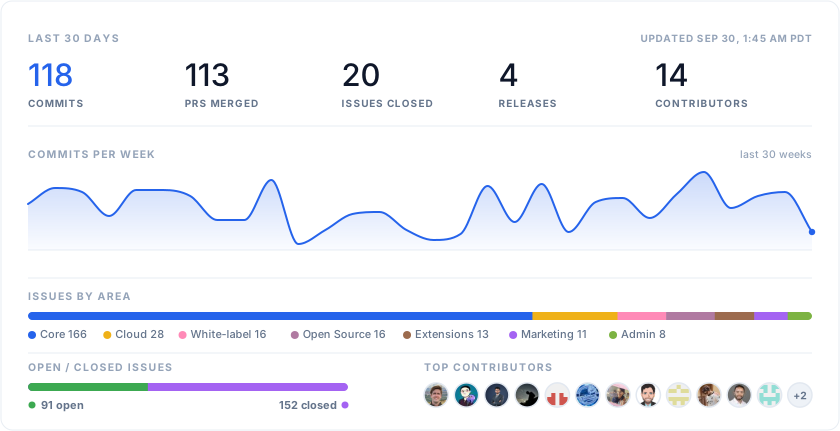
See CONTRIBUTING.md, the developer guide, and good first issues.
Elmo is open source under the MIT License.