




Publishio is AI publishing that follows your design system. Connect ChatGPT, Claude, or any Model Context Protocol (MCP) client directly to WordPress, then build pages and posts just by chatting. The AI builds from your site's own block patterns first, and writes native WordPress blocks styled by your theme for everything else — so the result matches your brand either way.
Publishio is not another AI writer, and it is not a page builder that reinvents your layout. It is a native MCP server for WordPress — the bridge between the AI you already use and your site. Because the AI works from the patterns your designers already approved and your theme's own block styles, your layout, spacing, colours, and typography stay exactly as intended. That's the difference between generic AI output and on-brand AI content that matches your design.
Everything runs on your own site. There's no third-party service in the middle: your WordPress site exposes its own MCP endpoint, and ChatGPT or Claude connect straight to it over an authenticated connection you control. Editors and content teams can ship landing pages, blog posts, and campaign pages in minutes, in plain language, without touching the designer's work or breaking the design system.


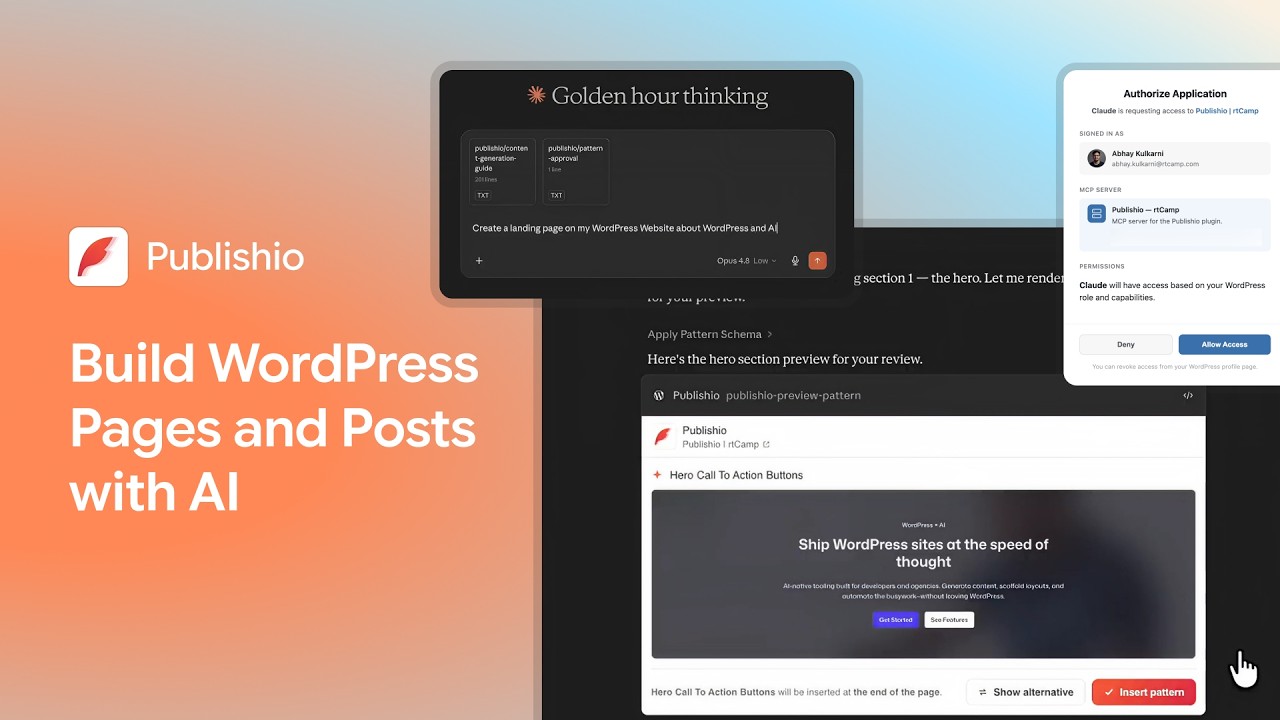
- Follows your design system: The AI starts from your site's own block patterns and uses native blocks styled by your theme — so content inherits your existing layout, spacing, and brand instead of generic markup.
- Connect ChatGPT, Claude, and other MCP clients: A standard MCP server for WordPress that works with ChatGPT, Claude, Claude Code, and other MCP clients that support Client ID Metadata Documents (CIMD).
- All your patterns: Uses every pattern on your site — from your theme, plugins and core, and the synced and unsynced patterns saved in your pattern library. The AI can save new sections as patterns when you ask.
- Edits any block: The AI adds, changes, moves, copies and removes blocks one section at a time. Every change is checked before it's saved, so content opens cleanly in the Block Editor.
- Plan first, then previews: The AI proposes the whole plan and waits for your yes before it writes anything. In apps that show previews, you see each section as it's added, every pattern it saves, and the finished page with how it looks in search results and as a shared link.
- Live pages are safe: A change to a published, scheduled or private page needs your OK in the chat first, and the AI can't publish.
- SEO & metadata: Adds the slug, excerpt, featured image, categories and tags, and Yoast SEO fields, on posts, pages and custom post types.
- Runs on your own site: A self-hosted MCP endpoint with OAuth — no third-party service in the middle.
- Theme agnostic: Works with any block-based / FSE theme.see: compatible themes

This plugin includes a skill file, the Publishio content guide, that teaches AI assistants how to build WordPress content well — planning first, using your site's existing patterns, building one section at a time, and following your design system rather than inventing markup.
Connected AI assistants read the guide automatically through MCP, so editors and content creators don't need to configure anything. To install it as a skill too, use Download SKILL.md on the Publishio page in your dashboard; it always matches the installed version.
To use the skill in Claude (claude.ai):
- Download the skill file
- Open Claude Web and go to Customize → Skills → Upload Skill
- Upload the downloaded file
- Start prompting Claude to build WordPress pages using your theme's patterns
- WordPress 6.9 or higher
- Pretty permalinks (any Permalinks setting except Plain). AI apps can't connect with Plain permalinks.
- AI apps must be able to reach your site. Addresses under
/.well-known/and/wp-json/must reach WordPress for visitors who aren't logged in. Some web servers and firewalls block/.well-known/; Publishio → Status checks this for you.
- Tested this plugin with Twenty Twenty-Five and Ollie.
- Compatible with any theme. For best results, ensure patterns have descriptive names and descriptions. (see: Why your theme's patterns need proper names and descriptions)
This plugin acts as a bridge between your WordPress theme and AI assistants. Here's how it works:
- Pattern discovery — the plugin lists the patterns registered on your site via
WP_Block_Patterns_Registry, and the patterns saved in your pattern library. - Metadata sent to AI — each pattern's
title,descriptionandcategoriesare sent to the AI as structured data. The actual block markup is fetched separately, on demand. - AI selects a pattern — the AI reads the pattern metadata, picks the pattern that best fits each section, and names it in the plan you approve.
- Content is added — the AI inserts the pattern as it is, then changes its text, links and images block by block.
- Preview — in apps that show previews, each section appears in the chat as it's added.
When a pattern has no description (or a generic one), the AI has only the title to work with for matching. A title like "Hero Section" doesn't tell the AI whether it's a full-width hero, a split hero with an image, a centered hero with a CTA, or a hero with a background video. The AI must then fetch the full content of every pattern that matches a keyword — adding expensive round trips — just to understand what each one looks like.
What the AI sees:
- Patterns with rich metadata → the AI matches confidently in one round trip.
- Patterns with no metadata → the AI either skips them or fetches every candidate's full content to reverse-engineer their purpose.
Bottom line: The more descriptive your pattern names and descriptions, the better the AI's output. Theme authors should treat pattern metadata as documentation for AI — not just a label for the block inserter.
- Install and activate the plugin in your WordPress dashboard.
- Ensure you meet the Requirements (WordPress 6.9+, PHP 8.2+, pretty permalinks).
- Open the Publishio page in your dashboard. It shows your site's MCP server URL and step-by-step guides for connecting Claude and ChatGPT; other MCP clients connect to the same URL (see the FAQ).
- Add the connection in your AI, authorize it, and start prompting it to build pages and posts from your patterns.
Q: Will it change my design? A: No. Publishio builds pages from your site's own block patterns and your active theme's styles, so new content inherits your existing layout, spacing, colours, and typography. It doesn't restyle your site, edit your theme, or invent CSS — the AI assembles content from the building blocks your designers already approved. You approve the plan in the chat before anything is written, and nothing goes live until you publish it in WordPress.
Q: How do I connect ChatGPT to WordPress?
A: Publishio exposes a standard MCP server on your own site at https://your-site.com/wp-json/mcp/publishio (your exact URL is shown on the Publishio dashboard page). In ChatGPT, add that URL as a custom MCP connector and authorize it — Publishio handles authentication with OAuth. The Publishio dashboard includes a step-by-step ChatGPT setup guide alongside the Claude guide.
Q: How do I connect Claude to WordPress? A: Open the Publishio page in your WordPress dashboard. It includes a complete, step-by-step guide for adding your site's MCP server to Claude and authorizing the connection.
Q: An AI app says it couldn't connect. What should I check?
A: Open Publishio → Status in your dashboard. It checks your site the way an AI app does and names the step that fails, such as a web server blocking /.well-known/ or a security plugin blocking the REST API, with how to fix it. Copy the report it gives you and send it to your developer, your host or rtCamp, or paste it into Claude or ChatGPT and ask it to walk you through the fix.
Q: Does my content and data stay on my site? A: Yes — Publishio adds no third-party service. It runs entirely on your own WordPress site as a self-hosted MCP server, and your site connects directly to the AI you choose; nothing is routed through rtCamp or any Publishio-operated cloud. The pages and posts you create live in your own database, exactly like any other WordPress content. The only data that leaves your site is what you send to your chosen AI assistant (ChatGPT or Claude) during a chat — the same as using that assistant anywhere else — governed by that provider's terms.
Q: Does it support custom post types? A: Yes. Publishio works with any post type that uses the Block Editor — pages, posts, and custom post types (e.g. portfolio, product, event). Featured images, categories, tags and Yoast fields work on every type that has them. Just tell the AI which post type to create.
Q: Does it work with AI platforms other than ChatGPT and Claude? A: Yes, if the app supports Client ID Metadata Documents (CIMD), the OAuth sign-in method the MCP specification recommends. Claude (web, desktop, and Claude Code) and ChatGPT support it. Cursor, Gemini CLI, and Windsurf only support the older dynamic client registration, so they can't connect until they add CIMD support.
Q: Do I need a specific theme? A: No, it works with any block-based / FSE theme. Themes with well-described patterns (like Twenty Twenty-Five) yield the best results, because the AI matches patterns from their names and descriptions.
Q: Does the AI publish directly, or can I review content first? A: You're always in control. The AI proposes the whole plan, with the pattern for each section, and waits for your yes before it writes anything. In apps that show previews, you see each section as it's added and the finished page with its search and social details; in other apps, the AI shares the preview and editor links. A change to a published page needs your OK in the chat first. The AI can't publish: everything stays a draft until you publish it in WordPress.
Q: Can the AI change my saved patterns? A: Only when you ask, and only unsynced patterns from your pattern library. Pages that already use an unsynced pattern keep their own copy, so they don't change. Synced patterns and your theme's and plugins' patterns are never changed; on a page, the AI can only change a synced pattern's override values for that page.
Q: Does it work with classic (non-block) themes? A: Publishio is designed for block-based and Full Site Editing (FSE) themes. Classic themes without block editor support are not recommended — the AI generates Block Editor content that requires block-aware themes to render correctly.
Q: Will it work with page builders like Elementor or Divi? A: No. Publishio generates native WordPress block markup for the Block Editor. Page builder shortcodes and proprietary formats are not supported.
- Development Guide - Setup, commands, testing, and contribution.
- Contributing
- Code of Conduct
- Security
├── .github/workflows/      # CI/CD workflows
├── assets/                 # Static assets (CSS, images)
├── docs/                   # Development guides and references
├── framework/              # Reusable framework (shared across plugins)
├── inc/                    # Plugin-specific PHP source
│   └── Modules/
│       ├── MCP/            # Model Context Protocol abilities
│       └── Settings/       # Plugin settings and connections
├── src/                    # TypeScript/JS entry points
├── templates/              # Admin screen and OAuth consent templates
└── tests/                  # PHPUnit and Jest tests
See ./docs/DEVELOPMENT.md for a detailed directory tree and descriptions.
@Utsav-Ladani @danish17 @aviral-mittal @HiAbhayKulkarni @justlevine @jayson31 @muralig-hub @dipankardas011
GPL-2.0-or-later. See LICENSE.md.